
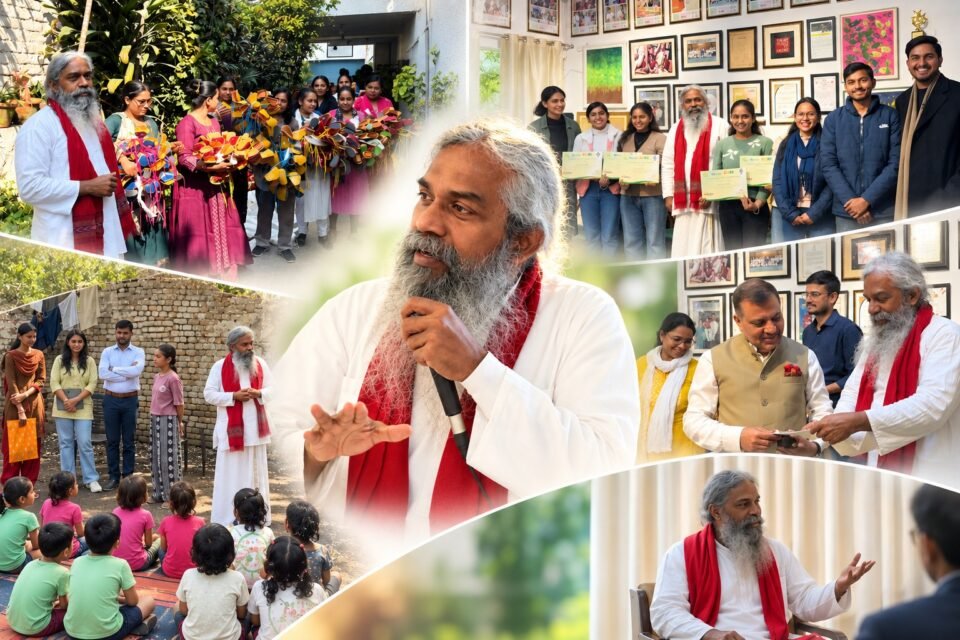
Dr. Santhosh has been working on a straightforward yet effective concept for over thirty years: complex solutions are not necessarily necessary to solve some of society’s most pressing issues. Meaningful change frequently starts with recognizing an issue, coming up with a workable solution, and remaining dedicated long enough to make that answer available to those who most need it.
He is a social entrepreneur who founded CURE India, Health Ashram, Children in India, WePlant India, and Indian Samaritans. For over 30 years, he has worked in the areas of community welfare, education, nutrition, healthcare, pediatric disabilities, and environmental sustainability.
Dr. Santhosh has been working on a straightforward yet effective concept for over thirty years: complex solutions are not necessarily necessary to solve some of society’s most pressing issues.
A Problem That Was Difficult to Ignore
One of the defining moments in Dr. Santosh’s journey came from seeing children born with clubfoot, a treatable congenital condition, without access to appropriate care.
To get medical care, families in isolated and underdeveloped areas could have to travel hundreds of kilometers to visit a physician or hospital. The cost of therapy may make access even more challenging, and many parents were ignorant of the illness.
Dr. Santosh saw mothers travelling long distances carrying their children, hoping to find someone who could help.
The challenge was not simply the absence of treatment. The larger problem was ensuring that an effective treatment could actually reach children regardless of their location or economic circumstances.
That realization eventually led to the creation of CURE India in 2009.
CURE India: Taking Clubfoot Care Closer to Children
A child shouldn’t have to live with a treatable condition just because treatment is unavailable or too expensive, according to CURE India’s simple founding goal.
What began as a focused initiative gradually developed into a large-scale programme.
Today, CURE India operates across 27 states and has grown into what the organisation describes as the world’s largest programme dedicated to clubfoot treatment in children.
More Than 1,30,000 Children Reached
Over 1,27,000 kids have benefited from the program’s free, non-surgical Ponseti Method clubfoot treatment.
Furthermore, CURE India has trained more than 10,000 doctors nationwide, advancing treatment capacities and knowledge to enable families to obtain care closer to their homes.
These figures are the result of thousands of individual stories—children who have been given more chances to play, walk, go to school, and participate more independently in daily life.
This experience also showed Dr. Santosh something bigger: when a system is designed to offer a relatively modest intervention at scale, it may have a substantial impact.
From One Solution to a Wider Mission
CURE India was only one part of the journey.
Dr. Santosh faced difficulties that went beyond physical infirmity as he continued to work with kids and families. Environmental problems, community health, malnutrition, developmental delays, and restricted educational opportunities were frequently linked.
Instead of considering each issue separately, he started creating programs intended to fill various gaps in the greater social ecosystem.
WePlant India: Connecting Nutrition With the Environment
In order to plant native fruit trees in public spaces, Dr. Santosh founded WePlant India in 2013.
The concept integrates environmental sustainability with nutrition. In addition to fostering greener communities and biodiversity, fruit-bearing native trees can produce a potentially valuable nutritional resource in public spaces.
The initiative reflects a recurring theme in Dr. Santosh’s work: looking for practical interventions capable of addressing more than one challenge at the same time.
Indian Samaritans: Responding to Community Needs
The same year also saw the establishment of Indian Samaritans, an initiative focused on ensuring education for Children from vulnerable communities and migrant labourers.
Its development followed the philosophy visible throughout Dr. Santosh’s work—understand challenges at the grassroots level, identify practical interventions and create structures that can continue serving communities over time.
Children in India: Helping Children Find a Place in Mainstream Education
Another challenge became increasingly visible through Dr. Santosh’s work: children with disabilities and developmental delays were often missing opportunities for early intervention and education.
In 2019, he founded Children in India to help address this gap.
The program focuses on early detection and intervention while assisting children with disabilities and developmental delays in finding pathways into mainstream education when suitable. It collaborates with parents, communities, and government schools.
The concept is founded on the core tenet that a disability shouldn’t inevitably result in exclusion from opportunities, participation, or education.
For families who may not know where to seek help, early guidance can make an enormous difference to a child’s development and future.
Health Ashram: Looking at Health Beyond the Hospital
In 2020, Dr. Santosh founded Health Ashram, extending his work into another area he believed required a different approach.
The fundamental tenet of Health Ashram is that hospitals cannot produce health on their own.
Hospitals are essential for treating illness, but long-term health is also impacted by lifestyle, nutrition, prevention, awareness, families, and living conditions.
As a result, Health Ashram was created around a more comprehensive, community-focused perspective of health—one that makes discussions about wellbeing and prevention more relevant to people’s daily lives.
A Philosophy Built Around Simple Solutions
Despite working in a variety of sectors, Dr. Santosh’s activities are connected by a common concept.
He thinks complex solutions at all levels are not always necessary for problems like hunger, disability, malnutrition, climate change, water scarcity, and unequal access to healthcare.
Sometimes, the solution already exists. The real challenge is creating a system capable of taking it to the communities that need it.
Dr. Santosh discussed this philosophy during his TEDx talk at Christ University, highlighting the potential of simple ideas when they are implemented patiently and consistently.
His work suggests that impact does not always begin with a massive institution or a highly complex intervention. It can begin by identifying one overlooked problem and asking how an existing or practical solution can reach more people.
Education, Research and Learning From Communities
Dr. Santosh’s academic background has impacted his approach to problem-solving in addition to his social impact activities. After decades of fieldwork, he added an academic and research viewpoint with his PhD from Madurai Kamaraj University in 2004.
However, a large portion of his knowledge has also been gained outside of official institutions.
His comprehension of how social issues function at the local level has been aided by the experiences of parents seeking treatment, physicians providing care, educators assisting kids, families dealing with dietary issues, and communities with inadequate resources.
An approach centered on workable, scalable, and community-oriented solutions has been shaped by this blend of academic knowledge and hands-on experience.
Three Decades of Turning Problems Into Possibilities
Dr. Santhosh has worked in the fields of healthcare, developmental disabilities, education, child development, nutrition, environmental sustainability, and community welfare for more than 30 years.
The organizations he formed tackle a variety of issues, but they all begin with seeing a problem that affects everyday lives and refusing to accept that it must go unresolved.
The goal of CURE India has been to increase access to clubfoot therapy.
Children in India, it has extended to early intervention and educational inclusion.
WePlant India, the approach connects nutrition with environmental action.
Meanwhile, Indian Samaritans, it reaches broader community welfare.
And through Health Ashram, it challenges the idea that health begins and ends at the doors of a hospital.
The Work Is Far From Finished
The programs that he has assisted in creating are substantial in scope, yet the problems that motivated them are still pervasive.
Many children and families in India continue to confront obstacles to early intervention, proper nutrition, healthcare, and education. Communities still struggle with issues that might have practical answers but lack the infrastructure to implement them.
That is perhaps the central theme running through Dr. Santhosh’s journey.
His story is not simply about founding multiple organisations. It is about repeatedly asking a practical question: if a solution exists, how can it reach the person who needs it most?
More than three decades after beginning this work, the philosophy behind his efforts remains remarkably simple:
See the problem. Find a practical solution. Take it to the people who need it. And stay with the work long enough to create meaningful change.
